
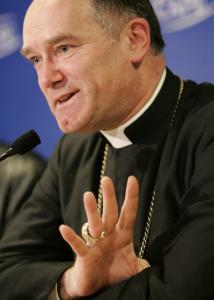
Monseñor Bernard Fellay ha dado una entrevista al diario suizo Le Nouvelliste, después de una Misa de Requiem celebrada el sabado en Écône en sufragio por unos seminaristas de la Fraternidad fallecidos hace poco tiempo. El blog Rorate Caeli la traduce al inglés, de donde la tomamos para hacer esta traducción.
*
Monseñor Bernard Fellay, ¿en qué fecha regresará al Vaticano?
No se ha establecido una fecha. Después de la tormenta que ha tenido lugar, todos necesitaremos calmarnos.
*
Y las discusiones que aceptó tener desde ahora con Roma, ¿se realizarán pronto?
Para eso, aún no hay fecha… pero sí, comenzarán.
*
¿Estas discusiones tardarán mucho? ¿Tienen una agenda?
Pueden tomar mucho tiempo si consideramos lo que acaba de suceder. No por nosotros, sino por las reacciones en la Iglesia entera, particularmente acerca de nuestras posiciones sobre el Concilio Vaticano II. El Concilio incluyó muchas palabras ambiguas en sus textos, para obtener una más grande mayoría. Hoy estamos pagando por esto.
Los textos no son claros, y existe una multitud de diferentes interpretaciones que son aceptadas dentro de la Iglesia. Si no deseamos el colapso de la Iglesia, son urgentes las clarificaciones sobre este Concilio, que quiso ser pastoral y no dogmático. Juan Pablo II ya dijo en 1982 que la herejía se había difundido abundantemente dentro de la Iglesia. Por eso nos alegra que Roma hable de las necesarias discusiones con nosotros para tratar las cuestiones básicas.
*
Pero Benedicto XVI ya tiene una interpretación precisa del Vaticano II.
En la audiencia que me concedió en el 2005, me dijo que la única interpretación posible del Vaticano II era la que sigue el criterio de la Tradición viviente. El 22 de diciembre del mismo año, condenó claramente la hermenéutica de ruptura con el pasado de la Iglesia. Pero esto es muy vago y amplio. Es necesario exponer al respecto.
*
El Papa ha realizado un gran paso hacia ustedes, pero uno tiene la impresión de que se encuentra de alguna forma solo, ignorado por un número de obispos que aparentemente no los quieren a ustedes en la Iglesia.
En un momento en que estamos hablando de un retorno a la plena comunión, el Papa efectivamente, quizá, se pregunta quién es más cercano a él, si ciertos obispos o nosotros.
*
Mediante el motu proprio sobre la antigua Misa y la remoción de las excomuniones que pesaban sobre ustedes, Benedicto XVI hizo gestos espectaculares y unilaterales. Pero, ¿cuáles serán sus gestos?
Ya hemos respondido afirmando nuestro deseo de seguir, con una mentalidad positiva, el camino de las discusiones indicado por el Santo Padre. Pero no hacemos esto precipitadamente. Cuando marchamos por un campo minado, se necesita prudencia y moderación.
*
Tiene, sin embargo, la esperanza de alcanzar un consenso doctrinal con el Papa…
Parece difícil. Es verdad, tenemos la impresión de que él es cercano a nosotros en la cuestión litúrgica. Por otra parte, él cree muy profundamente en las innovaciones del Vaticano II.
Será necesario ver qué parte de las divergencias se deben a diferentes filosofías. Una discusión seria demanda un mínimo de confianza.
En orden a establecer un clima más sereno, precisamente pedimos gestos a Roma, como la remoción del decreto de las excomuniones. Ahora esperamos que este trabajo traiga a toda la Iglesia una mayor claridad doctrinal. Hay, en efecto, muchas ambigüedades en el Concilio Vaticano II.
*
Son conscientes de que se les pedirá que acepten el Vaticano II.
Es lo que acaba de ser fuertemente reafirmado en la nota de la Secretaría de Estado del 4 de febrero del 2009. Pero la Santa Sede no puede conceder al Concilio una autoridad mayor que [la que el Concilio] deseó concederse a sí mismo.
Bueno, éste no ha deseado comprometer la infalibilidad, permanece en un grado mucho menor de autoridad. No será nunca un super-dogma, y debiera ser siempre visto según la perspectiva del constante Magisterio de la Iglesia. Ni la fe ni la Iglesia comienzan con el Vaticano II.
*
Y si se acercan a Roma, ¿temen una división en el interior de la Fraternidad?
No mucho, aunque siempre es posible. Podría existir tal riesgo si buscáramos de Roma un acuerdo puramente canónico y no una solución que se ocupe de las bases del problema, que es la crisis doctrinal y moral dentro de la Iglesia. Pero ese no es el caso.
*
Y finalmente, ¿qué hay de Monseñor Williamson, a quien usted pidió hacer declaraciones en un tiempo “razonable” acerca de la cuestión de la Shoah?
Está estudiando el asunto, y cumplirá con sus responsabilidades. Pero es necesario darle tiempo, porque quiere estudiar el asunto seriamente para dar una respuesta sincera y verdadera.
***
Fuente: Rorate Caeli
Traducción: La Buhardilla de Jerónimo
Fellay speaks after the storm
Monseigneur Bernard Fellay, at what date will you return to the Vatican?
No date has been set. After the storm that has taken place, we all need to pull ourselves together.
And the discussions which you accept to have from now on with Rome, are they for soon?
Still for that, no date… but, yes, they will begin.
Will these discussions take long? Do you have a timetable?
They could take very long if we consider what has just taken place. Not because of us, but because of the reactions in the entire Church, notably regarding our positions on the Second Vatican Council. The Council included many ambiguous words in its texts in order to attain a greater majority. We pay for this today.
The texts are not clear, and there is a multitude of different interpretations which are accepted within the Church. If we do not desire the collapse of the Church, clarifications on this Council, which wished itself to be pastoral and not dogmatic, are urgent. John Paul II already said in 1982 that heresy had spread abundantly within the Church. We are thus glad that Rome speaks of necessary discussions with us to deal with foundational questions.
But Benedict XVI already has a precise interpretation of Vatican II.
In the audience which he granted me in 2005, he told me that the only possible interpretation of Vatican II was that which followed the criterion of the living Tradition. On December 22 of the same year, he clearly condemned the hermeneutic of rupture with the Church’s past. But this is very vague and wide. It is necessary to expound on it.
The pope has accomplished a great step towards you, but one has the impression that he finds himself somewhat alone, disregarded by a number of bishops who apparently do not want you in the Church.
At a moment on which we speak of a return to full communion, the Pope is effectively, perhaps, asking himself who, between certain bishops and ourselves, is closer to him.
By way of the motu proprio on the ancient Mass and of the removal of the excommunications which weighed on you, Benedict XVI made spectacular and unilateral gestures. But what will be your gesture? A
We have already responded by affirming our desire to follow, with a positive state of mind, the path of discussions indicated by the Holy Father. But we do not with to do so precipitously. When we march on a minefield, prudence and moderation are necessary.
You have, nonetheless, the hope of reaching a doctrinal consensus with the Pope…
That seems difficult. True, we have the impression that he is close to us on the liturgical question. On the other hnd, he believes very deeply in the innovations of Vatican II.
It will be necessary to see what part of the divergences are due to different philosophies. A serious discussion demands a minimum of confidence.
In order to establish a more serene climate, we precisely asked Rome for gestures, wherefore the removal of the decree of excommunications. We now hope that this work brings to the whole Church greater doctrinal clarity. There are, in effect, too many ambiguities in the Second Vatican Council.
You are all the samer conscious that it will be asked of you to accept Vatican II.
Which has just been strongly reaffirmed in the note of the Secretariat of State of February 4, 2009. But the Holy See cannot grant to the Council a greater authority that [the Council] did not wish to grant itself.
Well, it has not wished to commit to infallibility, it remains on a much lowere degree if authority. It will never be a super-dogma and it should always be viewed according to the perspective of the cosntant Magisterium of the Church. Neither faith nor Chuch begin at Vatican II.
And if you move towards Rome, do you fear a division at the interior of the Fraternity?
Not much, but it is always possible. There could be such a risk if we sought from Rome a purely canonical agreement, and not a solution which concerns the foundation of the problem, which is the doctrinal and moral crisis within the Church. But that is not the case.
And, finally, Mgr Williamson, to whom you asked for declarations, in a «reasonable» time, on the question of the Shoah?
He is studying the matter, and he will fulfill his responsibilities. But it is necessary to give him time, because he wants to study the matter seriously to give a sincere and true response.


Me parecen interesante lo declarado por Mon. Fellay. No tiene sentido invitarlos a volver sin discutir ciertos puntos, aunque sea dificil que se pongan de acuerdo las posturas.
Creo que como defensor del CV II tengo las mismas dudas, yo no quiero volver atrás, pero minimamente debemos concedernos la posibilidad del diálogo.
Por lo que leo Mon. Fellay no toma esto como cuestión de vida o muerte y se pone su traje de Cruzado para matar infieles Cristianos conciliares.
Mesura, paciencia y no darle de comer a los lobos es lo que necesitamos en estos momentos.
No se apure amigo Villar, QUE AQUÍ no hay todavía CONVICCIONES de CRUZADO. Es por el momento la visita del «mensajero» de la Tradición al General en Jefe del ejército enemigo, previa a la batalla.
La única diferencia es que ROMA está velando armas y la Tradición suplicando y relevando a un coronel valioso y a soldados amotinados, con «estado deliberativo» en las huestes concientes de una «pirrica» victoria si la hubiere.
El hombre propone y Dios dispone. «NON NOBIS DOMINE,
NON NOBIS SED NOMINE,
TUO DA GLORIAM» cantaron los Templarios y un Papa a instancias de Felipe el Hermoso los mandó a la parrilla. Analoguemos con la situación actual: Papa a obedeciendo no ya a UN REY sino a LOS SEÑORES DEL MUNDO.
La LEY DE GRAVEDAD es una cosa muy cierta hasta en las cuestiones espirituales.
Es de esperar que la FSSPX no se deje sacar la escalera para aferrarse al pincel.
Vigilemos y Oremos PRO PAPADO.
«Que cosa más JUDAIZANTE que esperar un gran triunfo de la Iglesia ANTES DE LA 2da.VENIDA?»
«Én la medida en SE CREAN LAS PROMESAS , así SERÁN LOS MANDATOS»
(Castellani-«El Apocalipsis de San Juan»)
La fsspx no ha claudicado en nada. Lea la última entrevista a MSR TISSIER DE MALLERAIS del 11 de febrero de 2009 en Siracusa, publicado por Catholic Family News y se dará cuenta. No hay relevo ni amotinados, menos triunfos. La lucha recién empieza y lo que si veo es un grupito de paranoicos que solo critica y que quiere irse por supuesta defección de la fraternidad. Es mejor que se vayan, pero por favor no vuelvan mas, si es que alguna vez estubieron.
JOEL: no estás informado de lo de los padres Méramo y Abrahmovicz?
¿No fué RELEVADO Mons.Williamson?
¿En que «fraternidad» sentás tus «reales»?
No macanees, per amore al vero!
Ha vuelto el anglicanizado Joel y ya está echando gente e insultándonos al tratarnos de paranoicos.
Es el mismo que se ríe de la veneración de los santos y que insulta al Dr. Antonio Caponnetto.
Joel, sectario mas que nunca, vuelve a tu sinagoga de la que nunca debiste salir. Magro favor le haces a la Fraternidad con tus resentimientos y miserables odios.Y tus faltas de ortografía.
La promesa de Cristo es que nos van a hacer pomada pero que no seremos vencidos.
Las poromesas de este Roma, es que si nos dejamos vencer vamos a gozar de la paz del mundo…
que roma nos garantiza…
Lumasa
Joel
¿Porque no tiene la valentía de dar su nombre?.
Me hace acordar a otro que no se lo lee mas, desde que Fabián y el Padre Meramo le dijeron, que diera la cara, un tal Bruto o Brutus, que parece que se creía muy inteligente.
Joel
La tropa aveces, carga contra los jefes, para que no defeccionen, por amor y no por servilismo.
Quien ejerce la autoridad debe darse cuenta, que aquellos que no transigimos, lo hacemos para que gane la Verdad, los obsecuentes no les traerán problemas, pero en el momento de la lucha, desertarán.
Hay todavía buenos vasallos, que con buenos señores, no digo que avanzaremos, pero podremos resistir, que es lo que tenemos mandado.
Eh! Joel parecés un brava barra.
Joel tiene razón. Hay algunos muy apurados.
Hay que tener paciencia. Todo está tan enmarañado que no podemos
pretender que de un siglo al otro todo se solucione.
La suerte está hECHADA.
Lee lo de M. Tissier y después me cuentan. Puede entrar por secretum meum mihi de alli a cotholic family news y traduzcan. Lo de Abrahmovicz tengo entendido fue desobediencia manifiesta a pesar de ser advertido y lo de Méramo creo que no pasó de que un grupo de exaltados pidió su cabeza por posiciones supuestamentemente sedevacante. Me parece un error perder sacerdotes en estos momentos y mas si son de buena doctrina, pero para juzgar hay que conocer todas las circunstancias y yo no las conozco.
Joel, tienes razón. No es el momento de perder sacerdotes. Y menos perderlos por claudicar a los principios básicos de la lucha tradicionalista. El concilio siempre fue malo, no en letra ni en espíritu. Es malo en todo sentido. Y es un error perder buenos sacerdotes por cambiar esa verdad por el hecho de decir que nada más «tenemos reservas».
Rodrigo lee esto y despues me cuenta
Interview with Bishop Bernard Tissier de Mallerais, SSPX
The following interview was conducted by Catholic Family News Editor, John Vennari on February 11, 2009. It took place in Syracuse, New York at the time when Bishop Tissier de Mallerais visited Society of St. Pius X’s Blessed Virgin Mary, Mother of God Church to administer the sacrament of Confirmation and to give a Sunday evening speech. In this interview the Bishop speaks of Archbishop Lefebvre and the Social Kingship of Christ; the upcoming doctrinal discussions with Rome; the possible framework for “regularization”; and the SSPX’s position regarding the Second Vatican Council.
JV: Your speech in Syracuse on February 8 was entitled “Archbishop Lefebvre, the Priesthood and the Social Kingship of Christ”. What is the significance of this title?
BTM: I wanted to show that according to Father LeFloch, who was the teacher of Marcel Lefebvre in the French seminary in Rome, and according to Archbishop Lefebvre, the priesthood contains not only the sanctification of souls, but also the baptism of the nations. The integrity of the priesthood leads to the conversion of the nations so that civil society submits itself to Our Lord Jesus Christ. This is the full aim of the priesthood.
JV: In this speech, you had mentioned that the seminarians trained in the French Seminary under Father Le Floch constructed a three-point outline of how a revolution proceeds. Could you enumerate them?
BTM: I followed what Father Fahey explained from the teachers of the French seminary. They describe the three progressive points of the revolution.
First step of the Revolution: The elimination in government of Christ the King through the laicization or secularization of the State. Through this laicization, the civil law will no longer be submitted to the Gospel; and the Catholic religion will no longer be acknowledged publicly by the State. According to this revolutionary principle, the State is unable to give a judgment of truth about religion.
Second step of the Revolution: the suppression of the Holy Mass. Freemasonry wanted to do this at the end of the 19th and the beginning of the 20th Century with the separation of the Church and State. They hoped the Christian would lose the Faith and abandon the Church and the Holy Mass be no longer celebrated.
Third step of the Revolution: to make souls lose the Divine Life of Christ, so that souls do not live any more in the state of grace. To make pagan souls, to make laicized souls.
JV: How do you see the Second Vatican Council and its reforms in the light of this three-point outline?
BTM: With the Second Vatican Council, these three points were effectively accepted by the Church.
First, the destruction of the Catholic State by the Declaration on Religious Liberty; the separation of the Church from the State; the State is unable to give judgmentƒ of truth in matters of religion. That is what Cardinal Ratzinger explained to Archbishop Lefebvre in his interview of July 14, 1987; that the State is unable to know what the true religion is.
Second, the suppression of the Holy Mass. This happened after the Second Vatican Council with the New Mass. This New Mass does not express the sacrifice of propitiation. Rather, it expresses more an offering of the People of God, but not a sacrifice celebrated by the priest in order to atone for our sins. This second point was realized by the liturgical reform.
Third, the laicization of souls. This is practically the situation today because hardly anyone goes to confession. Most Catholics no longer go to confession. The sacrament of Penance has been practically suppressed with so-called general absolution. Now Rome wants a turning back to individual confessions, but I am sure that many bishops will not accept because many priests do not want to hear confessions.
JV: Yet there are a good number of priests out there who do want to hear confessions.
BTM: Yes, but in general, modern priests do not like hearing confessions, and do not encourage confession. Sin, Original Sin, the need for confession, and satisfaction for sin are no longer talked about. Statistically, there are few confessions in parishes. The result is the majority of Catholics who still may have the Faith cannot live in the state of grace. Let us be realistic, it is such a corrupt world, it is impossible to live in the state of grace without the Sacrament of Penance.
JV: You noted that Archbishop Lefebvre saw the answer to today’s crisis of Faith as consisting in a reversal of those three points. Can you elaborate?
BTM: Yes, take the revolution program but reversed.
First, to give the Holy Mass back to the faithful, so that they receive the graces coming from the Sacrifice of the Cross – through the true Mass. That is what we are doing with our faithful. We see the fruits of sanctification. We see many families with many children, and many vocations.
Second, through the traditional Mass and sacraments, to have souls living in the state of grace. That is the situation of our faithful. I think that most of them are living in the state of grace. They come regularly to confession in order to increase sanctifying grace or to recover it if they have the unhappiness to lose it. They are living in the state of grace. Children are living in the state of grace. Children are taught to fight against the occasions of sin.
Third, with this group of Catholics living in the state of grace, to make actions in order to “recrown” Our Lord Jesus Christ in society, to give Him back His crown. They do this in their homes, in our Catholic institutions, little-by-little in their jobs, in their professions, to make their professions run according to the law of Jesus Christ; to be a good example at work among fellow workers; all this ultimately for the re-Christianization of civil society.
JV: In your talk, you spoke of the modern notion of «personalism» as the philosophical error of the Second Vatican Council that has corrupted the doctrine of the Church.
BTM: This error corrupted the so-called Declaration on Religious Liberty, saying that everyone has the right not to be prevented from worshipping the Divinity according to his own mind. This comes directly from personalism.
The true definition of the human person was given by Boethius: an individual substance of a rational nature. The Thomist insists on “the rational nature”, because man has an intellect that is made to discover, to grasp, the truth; and to hold the truth. Thus the perfection of the intellect is to know the truth, because the truth is the object of the intellect. Thus the perfection of the human person consists in possessing the truth.
But now, the new “personalists” take the same definition of the human person, but stress rather the “individual substance”. The person consists of being an “individual”, so they must have rights according to their individuality. That is to say, to have liberty without consideration of the truth. By stressing the “individual substance”, the human person has the right of an “individual”, his own principles, his own choices, without consideration of the truth. The possession of the truth is not essential in the new definition.
This was the teaching of Jacques Maritain in France, who was a Thomistic philosopher, but converted to “personalism”. He had great influence on Pope Paul VI and on the Second Vatican Council.
Personalism insists that the individual must be free, must be independent, must choose by himself. In this consists “human dignity”. And this was condemned by Pope St. Pius X Letter to the French Bishops against Sillonism.
JV: Can you comment on what you said in your talk: the Church cannot keep the truth without fighting error?
BTM: The whole history of the Church demonstrates this principle. From the first centuries, the Church Fathers spent their time fighting heresies and condemning heretics. The Council of Nicea, the Council of Ephesus, are demonstrations of this truth. The Council of Trent was a splendid Council because it condemned Protestantism. Never does the Church put in clearer light her own principles than when fighting against heresies. Thus today the Church ought to condemn false principles in order to put into light her own principles, revealed principles. It is a necessity. The Church cannot teach the truth without fighting errors. It is the providential way that the good Lord established for the magisterium of the Church.
JV: Would you say that the new orientation of “dialogue” is a false substitute for condemning error?
BTM: Yes, under the pretext of “charity”. Saint Augustine says let us love the errants but fight the errors. But now it is also, let us love the errors, let us respect all these errors. Because error is always professed by persons, so if we respect the persons, we ought to respect their errors. It is subjectivism.
JV: In light of teaching the truth and resisting errors, what can you tell us about the upcoming doctrinal discussions between the SSPX and Rome?
BTM: According to the January 21 decree of Pope Benedict XVI, he declared he is open to these discussions, and I think they will be set up quickly.
JV: The SSPX, are formed in perennial Catholic magisterium of the centuries; formed according to the Syllabus of Blessed Pope Pius IX and the Syllabus against Modernism of Pope St. Pius X. The modern churchmen with whom you will have these doctrinal discussion are men who for the most part have been formed in the counter-syllabus of Vatican II; and in the new anti-anti-Modernism of the Council. Can we speculate how there will be a meeting of minds in the upcoming discussions?
BTM: Our intention is to put them in front of the contradiction between their doctrines and the traditional doctrines. We want to show them there is a real contradiction.
JV: How will these discussions proceed?
BTM: We intend to engage in a written discussion. We will put in writing our objections and they will respond. Perhaps toward the end there could also be face-to-face discussions.
JV: In these discussions, do you see language as a potential problem? For example, words such as «continuity» and «Tradition» are defined differently by the traditional Catholic and by present-day leaders in the Vatican.
BTM: It is difficult to discuss with people who have the same language but not the same meaning of the same words. So we will try to understand their philosophy and speak to them in terms of their own false philosophy. When we speak of “Tradition” we speak with them with an understanding of how they understand it; not to accept their new definition of it, but in order to understand their understanding of it.
JV: In 1988, the following was supposed to be on the original protocol between Rome and the SSPX: 1) that the SSPX get its own bishop; 2) that it has a majority in the Vatican’s Ecclesia Dei commission; 3) that the SSPX has autonomy from diocesan bishops. Will the SSPX still insist upon these when the time comes to talk about a juridical structure for the SSPX?
BTM: Yes, and it is what Rome is disposed to give. Cardinal Castrillon has already made some such plan, though the SSPX having a majority in Ecclesia Dei is not likely. As far as independence from the diocesan bishops, it appears Rome is ready to give us a structure that gives us a certain independence from the bishops, which is possible under Canon Law. I should note that we cannot rapidly seek out regularization. The doctrinal discussions will last a long time.
JV: One of the reasons I ask about autonomy from diocesan bishops is due to a recent statement from the Bishop Müller of Regensberg, Germany. Bishop Müller said that if the SSPX is regularized, they must also “accept that the seminary of Zaitzkofen falls under the supervision of the Diocese of Regensburg. The seminary should be closed and the students should go to seminaries in their home countries – if they are suitable for this purpose.”
BTM: We must have a juridical structure that protects us against such an enterprise of destruction from the bishops.
JV: If the SSPX is regularized, who would perform the ordinations and the confirmations?
BTM: Our own bishops. It would be contained in the final documents. But I must stress that this final juridical solution will not occur if Rome does not make a real conversion, because it would be impossible to obtain such a thing if Rome does not convert. It would not be possible to live such regularization without the conversion of Rome. I said this in an interview in La Stampa in Rome, and it was considered a scandal. Some said, “This bishop is ridiculous! What pretension! To convert Rome!” But that is our intention. It is clear. When we discuss with these people, it is to convert them.
JV: Since you’ve opened that topic, I’ll ask: Do you think the representatives in Rome also approach these discussions with the same intention: to convert the SSPX to a more councilor position? To make you “see the light”, or at least “feel the heat”?
BTM: Yes, that’s true.
JV: What about the fact that Archbishop Lefebvre signed all the documents of Vatican II, which means, some believe, that he saw no problems with the entire Council?
BTM: I have demonstrated in my biography of Archbishop Lefebvre – in the chapters on the Council – that the Archbishop felt at the time he could not refuse a decision of a general Council without separating himself from the Church. The great majority of the bishops signed the documents of Vatican II. Bishop de Castro Meyer signed all the documents of the Council. It was a collegial decision, and in a collegial decision, even if you do not agree with the decision, you have to sign it. For example, in the decree of nullity of marriage, there may be three or five judges deciding. If one judge does not agree, he will sign the decree anyway because the decision is taken as from the majority. Same thing with a general Council. It does not mean that Archbishop Lefebvre accepted all the decisions of the Council. For example, he voted to the very end against the document on Religious Liberty, and continued to publicly oppose Religious Liberty until his death in 1991.
Rather than read Vatican II in light of Tradition, we really should read and interpret Vatican II in light of the new philosophy. We must read and understand the Council in its real meaning, that is to say, according to the new philosophy. Because all these theologians who produced the texts of Vatican II were imbued with the new philosophy. We must read it this way, not to accept it, but to understand it as the modern theologians who drafted the documents understand it. To read Vatican II in light of Tradition is not to read it correctly. It means to bend, to twist the texts. I do not want to twist the texts.
JV: You had been with Archbishop Lefebvre from the beginning in 1969. You were with Archbishop Lefebvre in the three great landmarks of the SSPX in its dealing with Rome: the withdrawal of the permission for the seminary in Econe in 1975; the suspension in 1976; and the impasse with the Vatican that led to the Episcopal consecration in 1988. How does the present situation in 2009 compare/contrast with these earlier landmarks?
BTM: I think that from them nothing is changed. Ultimately, they want to take us back to the Second Vatican Council. To make us accept the decisions of the Second Vatican Council. The lifting of the excommunications did not affect this deep problem of the Faith. It did change something for those Catholics who do not understand our fight, who now see that we are not excommunicated, so this is a certain amount of good for the Church.
Related links:
• Pope Benedict Repeals SSPX Excommunicaitons
• SSPX Media Brochure
• DICI: Three Interviews with Bishop Fellay, Superior General of Society of St. Pius X
• The Biography of Marcel Lefebvre by Bishop Bernard Tissier de Mallerais
Joel
Insisto, ¿quién eres?
¿Te mandó el teologo Bruto o Brutus?
Acuerdense que nos somos soldados, solo somos obejas, aca falta humildad y obediencia. Viva Mons.Fellay y Mons.Williamson!!!!
Azul: Te hago saber que el profesor Caponetto nunca fue fiel tradicionalista, así que sus opiniones sobre algunas cosas debes tomarlas con pinzas.- Para confirmar lo que te digo preguntale al padre Ceriani, adonde NO lo mandó este profesor, en una carta, porque a su entender él, el P. Ceriani, ya estaba allí.- Muy posiblemente JOEL, conoce esa carta.- Las cosas claras.
“Ave Maria Purissima”
-Sine Labe Originale Concepta-
Sr. Director, caros hermanos en la única y verdadera Fe, participantes en general, saludos en los sagrados corazones de Nuestro Señor JesuCristo y la Sanísima Virgen María.
+
+
«A LOS TIBIOS, LES VOMITARE»
+
De tener verificativo el evento que el Presbítero anuncia, aunado a:
+
1.- La INJUSTA expulsión, de aquel apologista de la verdad, R.P. Abrahamovicz, por defender y proclamar Verdad, aduciendo una desobediencia a una orden que aún no había sido dada, (y que en apego a derecho canónico, totalmente injusta.
+
2.- La salida de la rectoría del seminario sito en la Reja por parte de S.E.R. Mons. R. Williamson, por decir Verdad.
+
3.- La monición recibida por el R.P. Méramo, y que contesta con el irrefutable estilo que le distingue (entrada antecedente).
+
4.- Los Hechos REALES, que pese a la retórica (dialéctica), pese a la “diplomacia, pese a la tolerancia, e incluso a la “obediencia” no tienen más que los siguientes resultados reales:
+
I.- El sumorum pontificum, que autoriza de forma extraordinaria, a la celebración de lo que denomina MISA tridentina, con un MISAL “Ligth” (Juan XXII), basándolo en que no ha sido Abrogado, (puede ser abrogado en cualquier momento) y totalmente INECESARIA ya que contamos con el permiso sobre el real Misal TRENTINO, estatuido en la Bula QUO PRIMO TEMPORE,
+
II.- El decreto que deja sin efectos, al anterior que proclamaba la excomuniones de los cuatro Obispos (Tramposamente, no se mencionan los CONSAGRANTES), daño explícitamente el matiz de magnanimidad, (te levanto el castigo) y que obviamente, al ser aceptado, también convalida de manera indubitable que existía no solo la consecuencia, sino el acto originario. También INECESARIO por que como sabemos, esas supuestas excomuniones, únicamente fueron mediáticas, SON NULAS DE PLENO DERECHO
+
Y
+
III.- Las declaraciones Oficiales por la directiva de la FSSSX, destacando entre ellas la Intención, de convertir a ROMA, y dejando (por lo menos) desestimado la palabra DIVINA.
+
Aunado al irrefutable hecho, de que los argumentos para tales determinaciones, son la facultad para que personas que sonríen con la tradición, puedan sin escrúpulos, acercarse al Rito Trentino, Argumento por demás estólido, toda vez que en lo personal, soy testigo de los sacerdotes que se encuentran en la Fraternidad, (NO TODOS), no administran sacramentos, a menos de conozcan de mucho tiempo a los padres del recién nacido, e incluso, no administran la confesión y extremaunción a quienes lo han menester, con el mismo criterio.
+
Ha habido una tendencia desde hace unos diez años, en la que los sacerdotes mas pensantes de la fraternidad, por distintas razones, ya no continúan en ella.
Y algunos otros “pequeños incidentes” como la desobediencia a la Voluntad del Fundador, S.E.R . Mons. Marcell Lefebvre de Santa Memoria, en el sentido, de que el dejo como superior de la Fraternidad (con autoridad por arriba de los cuatro Obispos) al R.P. Schmithberger, e incluso, el mismo fundador en vida, se sometió al Presbítero referido (dando el indubitable ejemplo y patentizando su voluntad del hecho).
Así, como “pequeñas” modificaciones en el llamado Manual del Ejercitante, de las que se destacan entre otras: el de 1970, antes de la Consagración, a la letra reza, (SIC.- Consagración de las Especies) como título genera, antes de entrar en materia, y el de 1995, con ambiguas ilustraciones, dice, Consagración del Pan, y Consagración del Vino. (¿SE VA PARECIENDO A LA MESA?
+
Y MUCHOS OTROS PEQUEÑOS DETALLES QUE, A QUIEN PUEDA MANTNERSE COMO DICE LA EPÍSTOLA DE SN. PABLO, VIGILANDO CON INTELIGENCIA, NO DEJARAN UN BUEN SABOR DE BOCA, POR EL INMINENTE RIESGO AL QUE LA TRADICION ESTA EXPUESTA EN ESTA EPOCA, (SABE QUE LE QUEDA POCO TIEMPO).
+
MAS VALE FRIO, ASI QUE LO QUE HAN DE HACER HACEDLO YA
LA ABOMINACION DE LA DESOLACION, YA ESTABA EN EL LUGAR SANTO, Y EL PRECEPTO, FUE “NI POR LA TUNICA”
+
+
+
SEA PARA GLORIA DE DIOS
Adolfo jesus. No se quien es Brutus o Bruto. Es la primera vez que intervengo en este blog. No me interesa agredir. Adhiero y colaboro con la Fraternidad desde hace bastante. No soy sedevante, pero los respeto, y creo que caen en esa posición por el escándalo que producen los que debieran guiarnos y que no hay que atacarlos sino tratar de hacerles ver su error. Me molesta los oportunistas y los sembradores de cizaña y hay muchos y con buena retórica. No me molesta que me agredan, pero si les molesta mis opiniones me retiro.
Joel
Nos cambiaron el libreto.
Nos piden silencio.
Adolfo jesus. No tienes remedio, lo siento por vos, me caias simpático. Cuandos empieces a razonar avisame y la seguimos.
Joel
Sobre la razón está el Misterio.
La verdad es que me tiene sin cuidado, que le haya caído simpático, pero no creo que en este blog, trasunte simpatía.
Usted me debe conocer personalmente, pero no se deja conocer.
¿A quien responde?